Downward arrow technique
箭头向下技术
What is the downward arrow technique?
The downward arrow technique is a common way to identify core beliefs in cognitive therapy: starting from an automatic thought, the therapist keeps asking what it means to the person until reaching a belief with no deeper meaning beneath it.[1] Beck and colleagues first mentioned it in 1979, and Burns elaborated it in 1980.[1]
Origins, data and limits
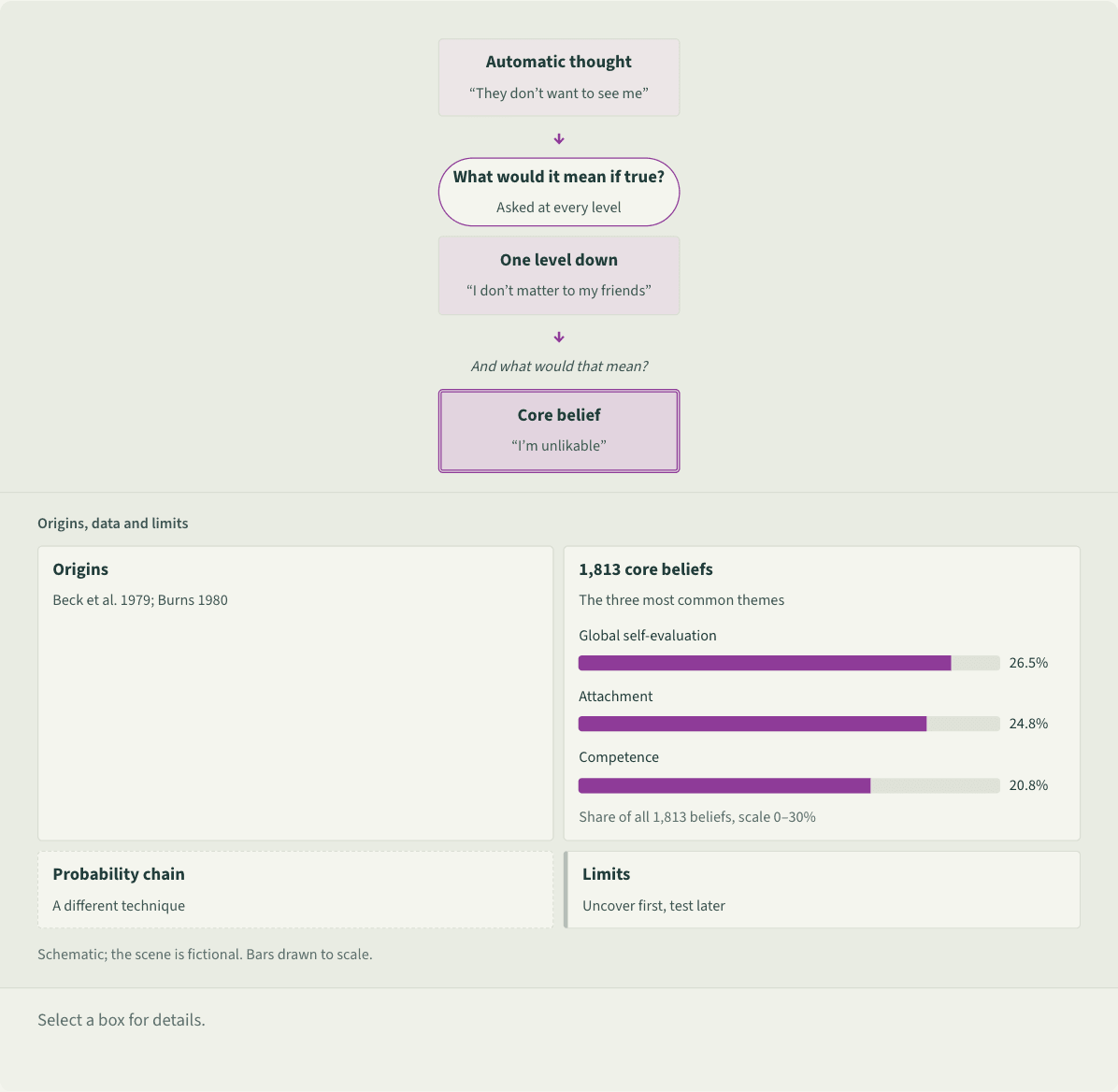
Schematic; the scene is fictional. Bars drawn to scale.
Schematic. Three cards from top to bottom joined by downward arrows. First, automatic thought: they don’t want to see me. Beside the first arrow: what would it mean if true? Second, one level down: I don’t matter to my friends. Beside the second arrow: and what would that mean? Third, with a heavy border, core belief: I’m unlikable. Below, labeled origins, data and limits, four cards: origins, 1,813 core beliefs, probability chain, and limits. The 1,813 core beliefs card holds three bars drawn to scale, as a share of all 1,813 beliefs on a scale from 0 to 30%: global self-evaluation 26.5%, attachment 24.8%, competence 20.8%.
 Save as image (PNG)
This figure image is licensed CC BY 4.0: reuse it with credit and a link back to this page. How to reuse
Key points
- An online CBT program has users start from an automatic thought they recorded, answer “What does that mean to me?” repeatedly, write down the core belief, then challenge it.[2]
- When 1,813 users’ core beliefs from the program were coded, the most common themes were global self-evaluation (such as “I am useless”), attachment and competence, together about 72%.[2]
- Therapists usually work with situational automatic thoughts first and with core beliefs later in treatment; core beliefs are so entrenched that they almost never change after one session.[1]
- A separate cumulative probability technique in anxiety treatment asks how likely a feared outcome is: list each step it requires, estimate each one’s probability, then judge how likely all are.[3]
An example
Jay invites two friends to his birthday dinner, and both say they are busy. He keeps thinking, “They don’t want to see me.” His therapist asks, “If so, what would that mean to you?” “That I don’t matter to my friends.” “And what would that mean?” “That I’m unlikable.” The therapist doesn’t argue but notes it to examine later.
Misreadings and limits
The technique uncovers a belief; it does not prove it. The core belief it reaches is then challenged.[2] Evidence is also limited: cognitive therapy as a whole has many randomized trials, but single strategies are rarely tested on their own,[1] and the first large study analyzed only the beliefs the technique produced, not outcomes.[2]
Sources
- 1 Wenzel, A. (2012). Modification of core beliefs in cognitive therapy. In I. R. de Oliveira (Ed.), Standard and innovative strategies in cognitive behavior therapy (pp. 17–34). InTech. doi:10.5772/30119
- 2 Millings, A., & Carnelley, K. B. (2015). Core belief content examined in a large sample of patients using online cognitive behaviour therapy. Journal of Affective Disorders, 186, 275–283. doi:10.1016/j.jad.2015.06.044
- 3 Gangemi, A., Gragnani, A., Dahò, M., & Buonanno, C. (2019). Reducing probability overestimation of threatening events: An Italian study on the efficacy of cognitive techniques in non-clinical subjects. Clinical Neuropsychiatry, 16(3), 149–155. View source
Last checked against sources: October 28, 2026