RULE principles
RULE 原则
What are the RULE principles of motivational interviewing?
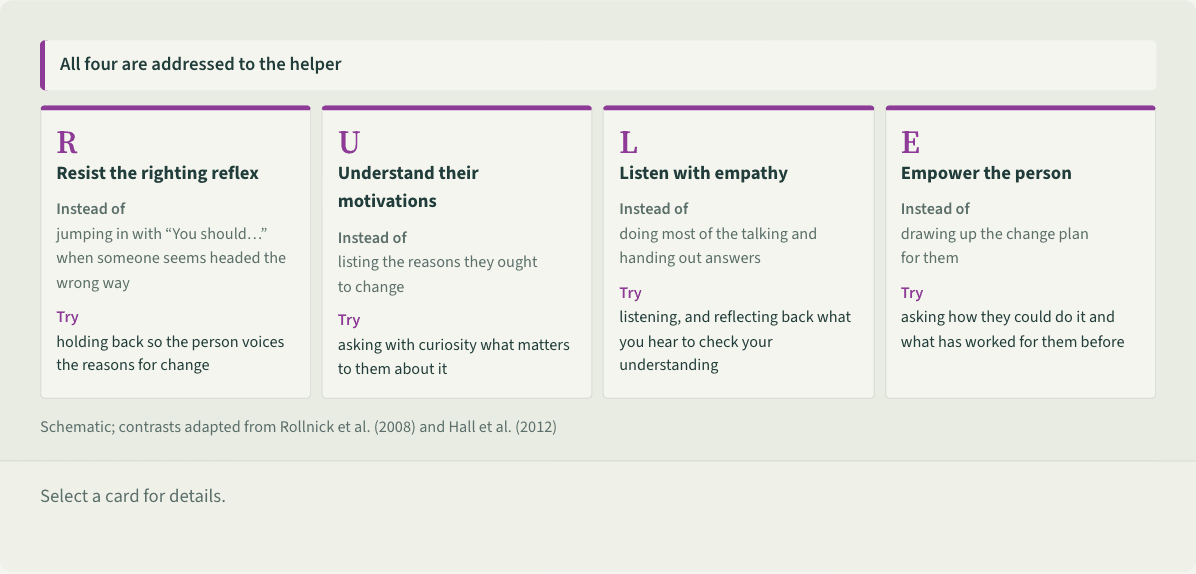
RULE is a mnemonic for four guiding principles of motivational interviewing that Rollnick, Miller, and Butler set out for health care practitioners in 2008: resist the righting reflex (the urge to correct), understand the patient’s own motivations, listen with empathy, and empower the patient.[1][2]
Schematic; contrasts adapted from Rollnick et al. (2008) and Hall et al. (2012)
Four cards side by side. R, resist the righting reflex: instead of jumping in with “You should…” when someone seems headed the wrong way, hold back so the person voices the reasons for change. U, understand their motivations: instead of listing the reasons they ought to change, ask with curiosity what matters to them about it. L, listen with empathy: instead of doing most of the talking and handing out answers, listen and reflect back what you hear to check your understanding. E, empower the person: instead of drawing up the change plan for them, ask how they could do it and what has worked before. A note above the cards says all four are addressed to the helper.
 Save as image (PNG)
This figure image is licensed CC BY 4.0: reuse it with credit and a link back to this page. How to reuse
Key points
- R: helpers feel a strong urge to set people right. But people naturally resist persuasion, especially when ambivalent, so pressing the case tends to make them defend the status quo.[1][2]
- U and L: the patient’s own reasons are most likely to trigger change, so explore their concerns and values with curiosity, and listen at least as much as you inform.[1][2]
- E: outcomes tend to be better when patients take an active role. Empowering means helping them work out how they could change, drawing on what has worked before, and conveying hope.[1][2]
- Some later MI texts leave RULE out; the 2013 third edition is organized around the spirit and four processes instead.[3][4] Some trainers still find it a handy memory aid for practitioners.[4]
An example
Jay drinks two or three sugary sodas a day. The dietitian holds back the lecture on sugar (R) and asks what he makes of it (U). He says he wants to keep up with his kids at their sports day; she reflects that back (L), then asks which first step he thinks he could manage (E).
Misreadings and limits
R is often misread as “people resist being lectured.” The one resisting is the helper, holding back their own urge to correct; people’s dislike of persuasion is the reason.[1][2] Earlier MI spoke of client “resistance,” a term the third edition split into sustain talk and discord.[3]
Sources
- 1 Rollnick, S., Miller, W. R., & Butler, C. C. (2008). Motivational interviewing in health care: Helping patients change behavior. Guilford Press. View source
- 2 Hall, K., Gibbie, T., & Lubman, D. I. (2012). Motivational interviewing techniques: Facilitating behaviour change in the general practice setting. Australian Family Physician, 41(9), 660–667. View source
- 3 Miller, W. R., & Rollnick, S. (2013). Motivational interviewing: Helping people change (3rd ed.). Guilford Press. View source
- 4 Schumacher, J. A., & Madson, M. B. (2015). Fundamentals of motivational interviewing: Tips and strategies for addressing common clinical challenges. Oxford University Press. doi:10.1093/med:psych/9780199354634.001.0001
Last checked against sources: October 27, 2026