Spirit of motivational interviewing
动机式访谈的精神
What is the spirit of motivational interviewing?
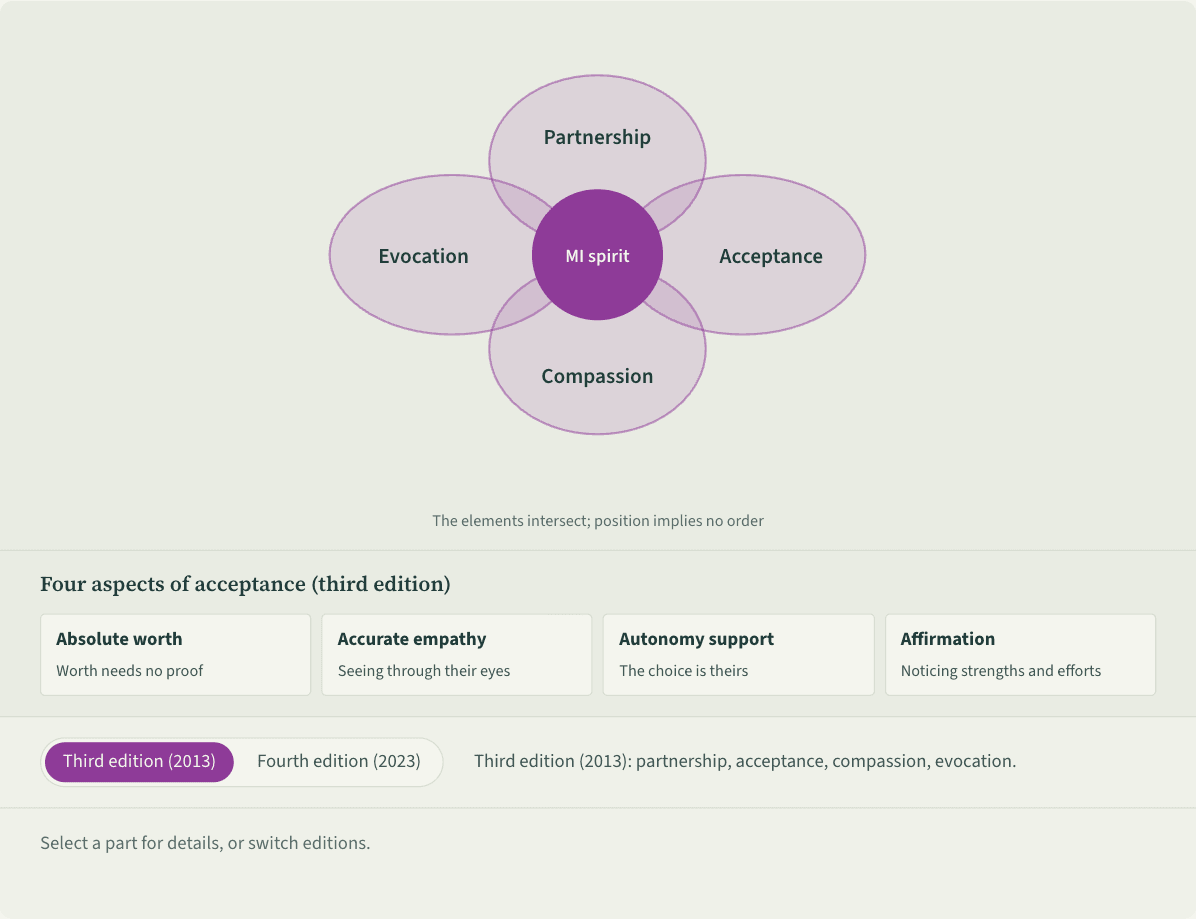
The spirit of motivational interviewing is the mind-set and heart-set a helper brings to the work. The third edition names four interrelated elements: partnership, acceptance, compassion, and evocation.[1] The 2023 fourth edition keeps the first three and replaces evocation with empowerment.[2]
The elements intersect; position implies no order
Four aspects of acceptance (third edition)
Schematic with two edition views. At the center is “MI spirit”; around it are four overlapping petals: partnership, acceptance, compassion, evocation. Below are the four aspects of acceptance: absolute worth, accurate empathy, autonomy support, affirmation. In the fourth-edition view, empowerment replaces evocation and autonomy support is marked as moving under empowerment; the rest is unchanged.
 Save as image (PNG)
This figure image is licensed CC BY 4.0: reuse it with credit and a link back to this page. How to reuse
Key points
- Acceptance is not approval. It has four aspects: absolute worth, accurate empathy, autonomy support, and affirmation. Their opposites are judging, imposing your own view, coercing, and hunting for what is wrong.[1]
- Compassion was added in the third edition because the other three can serve self-interest; a skilled salesperson uses them too. Compassion means giving priority to the other person’s welfare.[1]
- Fourth-edition empowerment keeps evocation’s premise, that people already hold much of what change requires and the helper’s task is to draw it out, and now includes autonomy support.[1][2]
- The widely used MITI 4 rates a 20-minute recording on Partnership, Empathy, and two technical scales, each scored 1 to 5; Partnership and Empathy average into a relational score.[3]
An example
Jay says he often drinks too much on weekends. Rather than listing the harms, his counselor asks what he makes of it (evocation). Hearing he wants more time with his daughter, she reflects that wish (empathy) and notes he skipped a night out last week (affirmation). Then: “Whether and how to change is up to you” (autonomy support).
Misreadings and limits
The elements are often taught as ordered steps. Miller and Rollnick describe them as interrelated elements that intersect, and as habits that practicing MI itself builds rather than prerequisites.[1][2] The popular PACE acronym is a memory aid from other authors.[4]
Sources
- 1 Miller, W. R., & Rollnick, S. (2013). Motivational interviewing: Helping people change (3rd ed.). Guilford Press. View source
- 2 Miller, W. R., & Rollnick, S. (2023). Motivational interviewing: Helping people change and grow (4th ed.). Guilford Press. View source
- 3 Moyers, T. B., Rowell, L. N., Manuel, J. K., Ernst, D., & Houck, J. M. (2016). The Motivational Interviewing Treatment Integrity Code (MITI 4): Rationale, preliminary reliability and validity. Journal of Substance Abuse Treatment, 65, 36–42. doi:10.1016/j.jsat.2016.01.001
- 4 Substance Abuse and Mental Health Services Administration (2019). Enhancing motivation for change in substance use disorder treatment (Treatment Improvement Protocol [TIP] Series No. 35). SAMHSA Publication No. PEP19-02-01-003. View source
Last checked against sources: October 27, 2026