DBT skills
辩证行为治疗技能
What are DBT skills?
DBT skills are the behavioral skills taught in the skills training of dialectical behavior therapy (DBT). They are grouped into four modules (mindfulness, interpersonal effectiveness, emotion regulation and distress tolerance) and aim to replace ineffective or maladaptive behavior with skillful responses.[1]
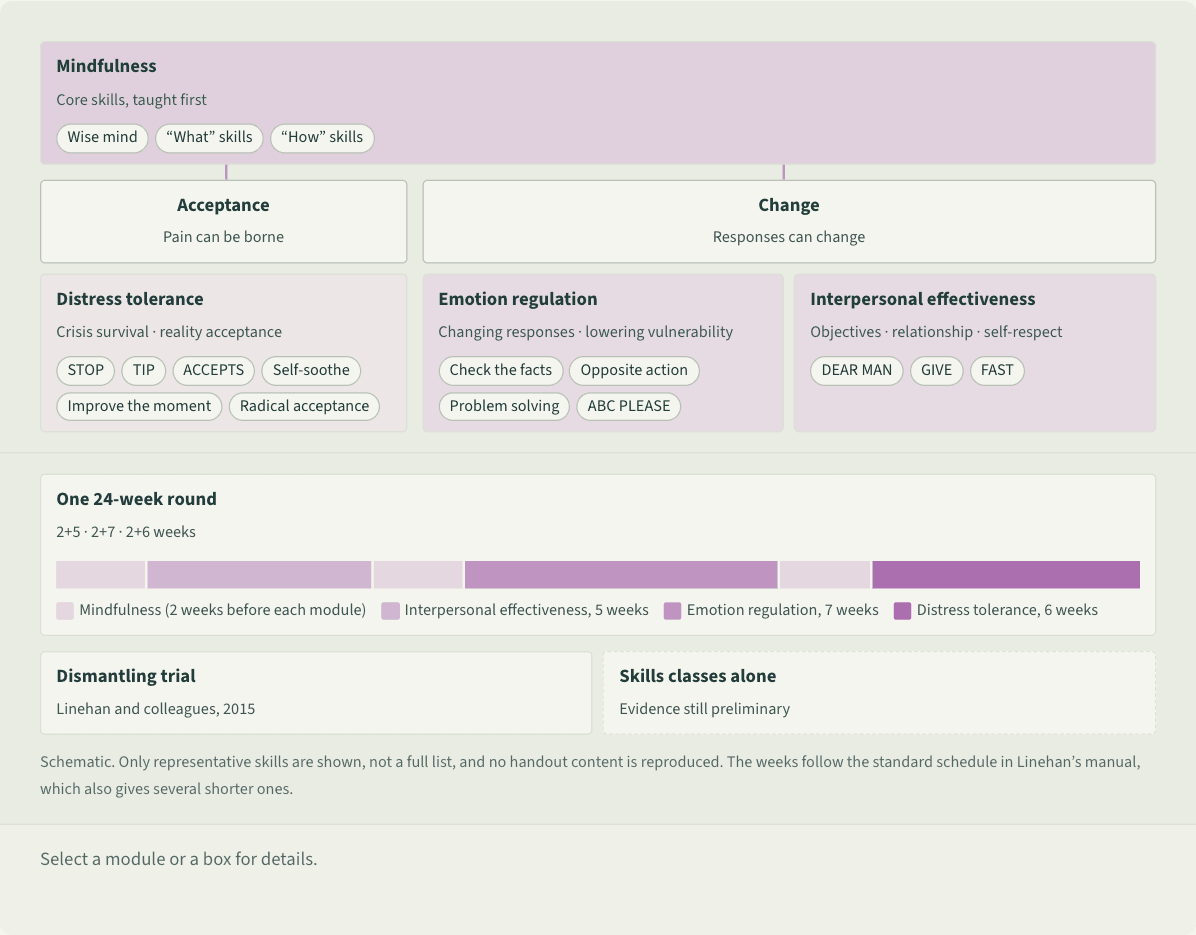
Schematic. Only representative skills are shown, not a full list, and no handout content is reproduced. The weeks follow the standard schedule in Linehan’s manual, which also gives several shorter ones.
Schematic. At the top, a box spanning the figure, mindfulness: core skills, taught first, with three tags: wise mind, what skills, how skills. Below, two columns. On the left, headed acceptance, a distress tolerance box tagged STOP, TIP, ACCEPTS, self-soothe, improve the moment and radical acceptance. On the right, headed change, an emotion regulation box (check the facts, opposite action, problem solving, ABC PLEASE) and an interpersonal effectiveness box (DEAR MAN, GIVE, FAST). Next, a bar in six segments for one 24-week round: mindfulness 2 weeks, interpersonal effectiveness 5, mindfulness 2, emotion regulation 7, mindfulness 2, distress tolerance 6. At the bottom, two boxes: the dismantling trial and skills classes alone.
 Save as image (PNG)
This figure image is licensed CC BY 4.0: reuse it with credit and a link back to this page. How to reuse
Key points
- DBT skills balance acceptance and change.[2] Distress tolerance teaches bearing pain and accepting reality; emotion regulation and interpersonal effectiveness aim at change. Mindfulness comes first and runs through all modules.[1]
- Distress tolerance has crisis survival skills, such as STOP, TIP (for example cold water to change body state fast), distraction and self-soothing, and reality acceptance skills such as radical acceptance.[1][2]
- Emotion regulation includes checking the facts, opposite action and PLEASE.[1][2] Interpersonal effectiveness uses DEAR MAN to reach objectives, GIVE to keep relationships and FAST for self-respect.[2]
- In a dismantling trial with 99 high-risk women with borderline personality disorder, suicide attempts fell alike in all three arms; the two with skills training did better on nonsuicidal self-injury and depression.[3]
An example
After a phone call with her mother, Lin is shaking with anger and wants to fire back a sharp message. She remembers the TIP skill from her skills group, holds cold water to her face for a while until her heart slows, and only then writes to suggest they talk in person on the weekend.[1][2]
Misreadings and limits
These acronyms are often taken as a do-it-yourself shortcut to DBT. The skills group is one part of standard DBT, which also includes individual therapy, phone coaching and a therapist consultation team.[1] A systematic review of 17 trials of skills training alone found preliminary support but too many methodological limits to judge its efficacy firmly.[4]
If you need help now
If you’re struggling to cope or having thoughts of harming yourself:
- US and Canada: call or text 988 (24/7)
- UK and Ireland: Samaritans, 116 123 (free, 24/7)
- Australia: Lifeline, 13 11 14 (24/7)
- Elsewhere: findahelpline.com
If you’re in immediate danger, call your local emergency number.
Psyfield is not a crisis service. Numbers checked October 2026.
Sources
- 1 Linehan, M. M. (2025). DBT skills training manual (Rev. ed.): Preface to the second edition and Chapter 2, Planning to conduct DBT skills training [publisher’s sample chapter]. Guilford Press. View source
- 2 瑪莎.林納涵(Linehan, M. M.) (2015). DBT®技巧訓練講義及作業單(馬偕醫院辯證行為治療團隊 譯)[DBT skills training handouts and worksheets, 2nd ed.]:目錄與內容連載. 張老師文化(博客來書目頁). View source
- 3 Linehan, M. M., Korslund, K. E., Harned, M. S., Gallop, R. J., Lungu, A., Neacsiu, A. D., McDavid, J., Comtois, K. A., & Murray-Gregory, A. M. (2015). Dialectical behavior therapy for high suicide risk in individuals with borderline personality disorder: A randomized clinical trial and component analysis. JAMA Psychiatry, 72(5), 475–482. doi:10.1001/jamapsychiatry.2014.3039
- 4 Valentine, S. E., Bankoff, S. M., Poulin, R. M., Reidler, E. B., & Pantalone, D. W. (2015). The use of dialectical behavior therapy skills training as stand-alone treatment: A systematic review of the treatment outcome literature. Journal of Clinical Psychology, 71(1), 1–20. doi:10.1002/jclp.22114
Last checked against sources: October 28, 2026