Grounding techniques
着陆技术
What are grounding techniques?
Grounding techniques are simple ways of using the senses, body movement or simple questions to shift attention from intense inner experience to the here and now, helping a person calm down and reorient.[1] They are used for flashbacks, intrusive memories, dissociation and overwhelming emotion.[2]
The 5-4-3-2-1 exercise
Three kinds in Seeking Safety
Use and evidence
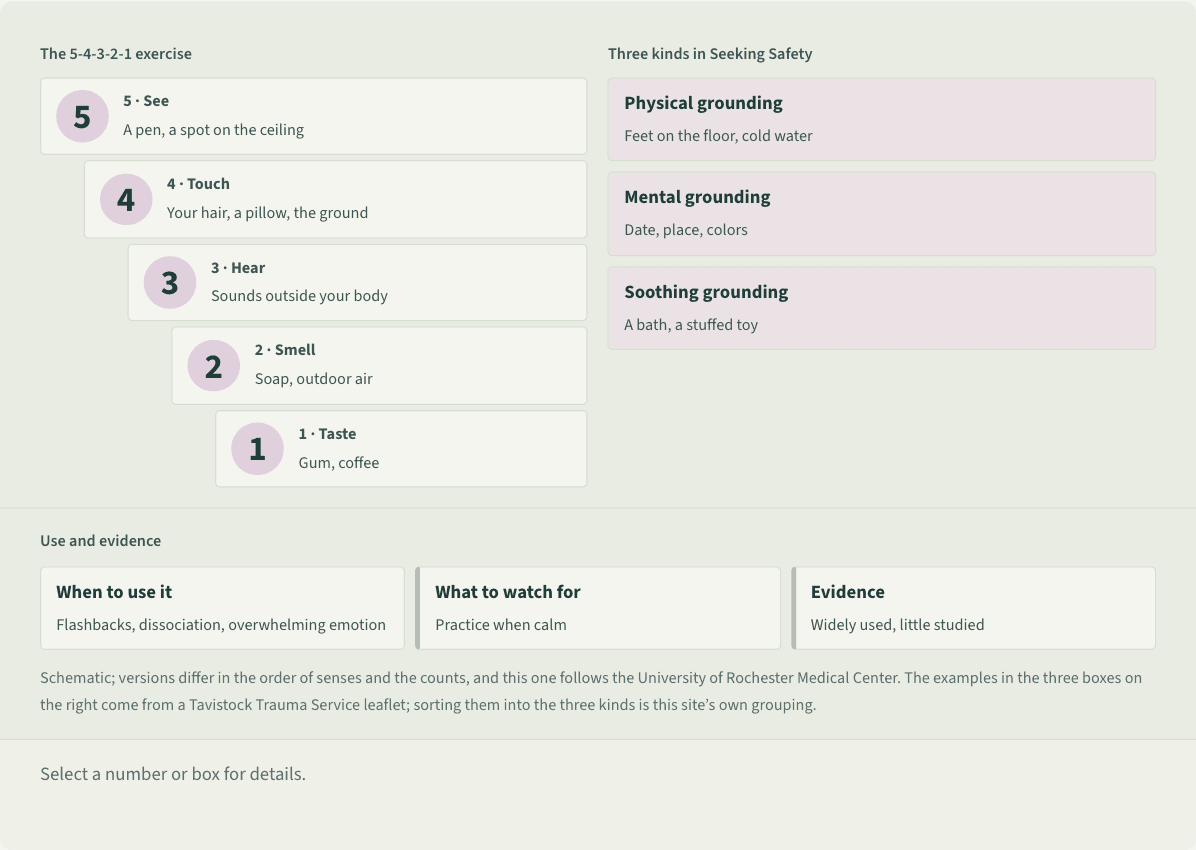
Schematic; versions differ in the order of senses and the counts, and this one follows the University of Rochester Medical Center. The examples in the three boxes on the right come from a Tavistock Trauma Service leaflet; sorting them into the three kinds is this site’s own grouping.
Schematic. On the left, a column of five numbers counting down: 5 see (a pen, a spot on the ceiling), 4 touch (your hair, a pillow, the ground under your feet), 3 hear (sounds outside your body), 2 smell (soap, outdoor air), 1 taste (gum, coffee). On the right, three boxes: physical grounding (feet on the floor, cold water on the face), mental grounding (date, place, finding colors), soothing grounding (a bath, a stuffed toy). Below, three boxes: when to use it (flashbacks, dissociation, overwhelming emotion), what to watch for (practice when calm), and the evidence (widely used, little studied).
 Save as image (PNG)
This figure image is licensed CC BY 4.0: reuse it with credit and a link back to this page. How to reuse
Key points
- In the 5-4-3-2-1 exercise you first slow your breathing, then name five things you see, four you can touch, three you hear, two you smell and one you taste.[3]
- Seeking Safety, a therapy for trauma and addiction, has 25 topics; grounding is one, taught in mental, physical and soothing forms that turn attention from negative feelings to the outside world.[4]
- Others: press toes into the floor, splash cold water on the face, sniff a sharp scent free of bad memories, or say aloud where you are, the date and that you’re safe.[2]
- Clinicians are advised to practice it during calm periods, watch whether a stimulus triggers trauma reactions, and return to sensory grounding before thinking-based methods when a person becomes incoherent.[1]
An example
Waiting in a hospital corridor for her father’s test results, Ms. Wang grows panicky, hands shaking, mind blank. She counts down 5-4-3-2-1: the queue screen, green chairs, a tree outside… the armrest, her sleeve, the call chime, disinfectant, the mint in her mouth. By the end she is breathing slower and can follow the calls.
Misreadings and limits
Grounding is widely used, but support for it is mostly clinical experience: a review found no study testing its effect, and two professional guidelines that mention it never define it.[1] It can help someone through a hard few minutes; if anxiety is a regular struggle and these methods do not help enough, see a doctor or mental health professional.[3]
Sources
- 1 Hammond, J., & Brown, W. J. (2026). Building an operational definition of grounding. Trauma, Violence, & Abuse, 27(4), 1340–1353. doi:10.1177/15248380251343189
- 2 Tavistock and Portman NHS Foundation Trust, Tavistock Trauma Service (2020). Grounding [Leaflet]. Tavistock and Portman NHS Foundation Trust (produced April 2020). View source
- 3 Smith, S. (2018). 5-4-3-2-1 coping technique for anxiety. Behavioral Health Partners blog, University of Rochester Medical Center (April 10, 2018). View source
- 4 Najavits, L. M. (n.d.). Seeking Safety treatment topics [excerpt from Seeking Safety: A new psychotherapy for posttraumatic stress disorder and substance use disorder]. Treatment Innovations (PDF); chapter in P. Ouimette & P. J. Brown (Eds.), Trauma and substance abuse (pp. 147–169), American Psychological Association. View source
Last checked against sources: October 28, 2026