Behavior chain analysis
行为链分析
What is behavior chain analysis?
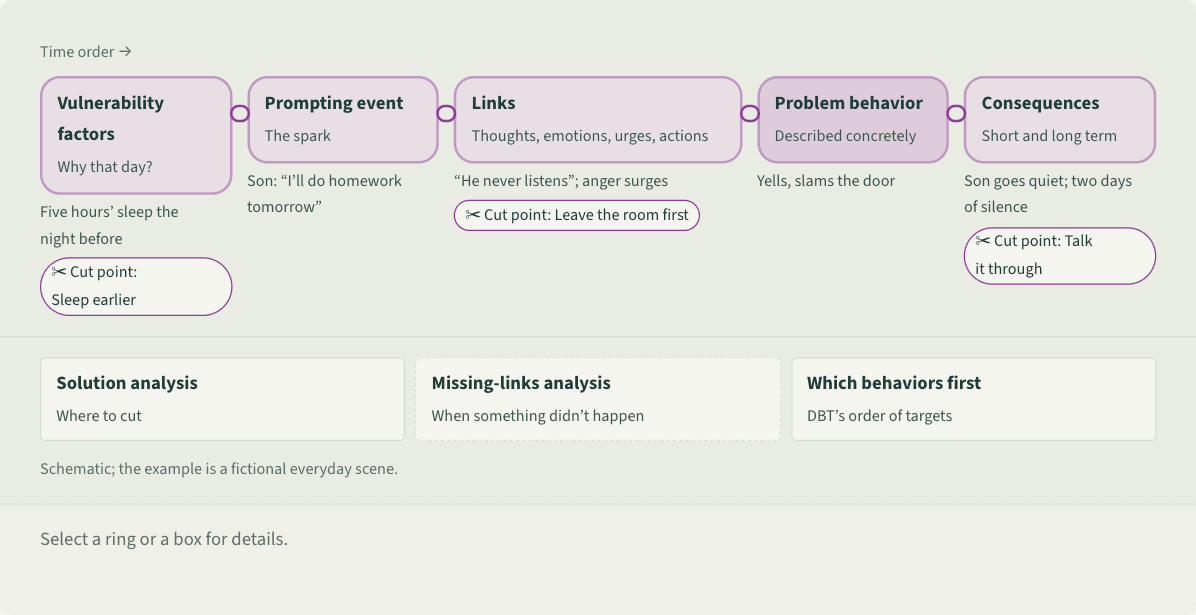
Behavior chain analysis is the core assessment method of dialectical behavior therapy (DBT). It lays out one episode of a problem behavior in time order, from vulnerability factors and a prompting event through the links to the behavior and its consequences, to find what drives it and where to break the chain.[1][2]
-
Five hours’ sleep the night before
Cut point: Sleep earlier
-
Son: “I’ll do homework tomorrow”
-
“He never listens”; anger surges
Cut point: Leave the room first
-
Yells, slams the door
-
Son goes quiet; two days of silence
Cut point: Talk it through
Schematic; the example is a fictional everyday scene.
Schematic. A chain of five rings runs from left to right under a label reading time order. Ring one, vulnerability factors: only five hours’ sleep the night before, with a cut point beneath it, sleep earlier. Ring two, prompting event: her son says he will do his homework tomorrow. Ring three, links: the thought he never listens and surging anger, with a cut point, leave the room first. Ring four, problem behavior: yelling and slamming the door. Ring five, consequences: the son goes quiet at once, then two days of silence, with a cut point, talk it through. Below the chain are three cards: solution analysis, missing-links analysis, and which behaviors come first.
 Save as image (PNG)
This figure image is licensed CC BY 4.0: reuse it with credit and a link back to this page. How to reuse
Key points
- Vulnerability factors are states that made the person more sensitive to the prompting event that day, such as poor sleep, skipped meals or illness; a long-standing diagnosis does not count.[1]
- Links are the thoughts, emotions, urges and actions, the person’s and others’, between the prompting event and the behavior; the emotion at each step, and how strong it was, should be clear.[1]
- Consequences are both short- and long-term. Immediate payoffs, such as the other person backing down or quick relief, can reinforce the behavior and make it likelier next time.[1][2]
- A solution analysis follows: skills replace key links, a plan cuts vulnerability, and harm is repaired.[2] When a needed behavior did not happen, missing-links analysis looks for what got in the way.[4]
An example
Ms. Wang yells at her son one evening and slams her door. Next day she and her therapist trace the links: five hours’ sleep; her son saying, “I’ll do homework tomorrow”; the thought “He never listens”; surging anger. He goes quiet at once, but they don’t speak for two days. Cut points: sleep earlier; leave the room as anger rises.
Misreadings and limits
Understanding a chain does not by itself change behavior; without motivation to change, analysis is not enough.[1] The step is also rarely tested on its own. In a meta-analysis of 23 randomized trials, CBT with a similar step was linked to fewer suicide attempts, but no trial was designed to isolate its effect.[3]
If you need help now
If you’re struggling to cope or having thoughts of harming yourself:
- US and Canada: call or text 988 (24/7)
- UK and Ireland: Samaritans, 116 123 (free, 24/7)
- Australia: Lifeline, 13 11 14 (24/7)
- Elsewhere: findahelpline.com
If you’re in immediate danger, call your local emergency number.
Psyfield is not a crisis service. Numbers checked October 2026.
Sources
- 1 Rizvi, S. L. (2019). Chain analysis in dialectical behavior therapy. Guilford Press. Chapter 1, The basics of the chain analysis (pp. 1–21), publisher’s sample chapter. View source
- 2 Navarro-Haro, M. V., Morillo, A. A., & García-Palacios, A. (2025). Applying dialectical behavior therapy as a transdiagnostic treatment in a case of borderline personality disorder and eating disorder. Journal of Clinical Psychology, 81(2), 102–112. doi:10.1002/jclp.23754
- 3 Janssen, W. C., Mérelle, S. Y. M., van Ballegooijen, W., Gilissen, R., & Bockting, C. L. H. (2025). Cognitive behavior therapy with and without narrative assessment and suicide attempts: A systematic review and meta-analysis. JAMA Network Open, 8(11), e2544632. doi:10.1001/jamanetworkopen.2025.44632
- 4 Oshin, L. A., & Rizvi, S. L. (2024). Considerations for the use of dialectical behavior therapy for individuals experiencing oppression. Psychotherapy, 61(4), 282–291. doi:10.1037/pst0000541
Last checked against sources: October 28, 2026